
Newton County Probate Division
The Newton County probate venue is the Probate Division of the 40th Circuit Court. It is not a separate county probate court with its own stand-alone clerk. The Circuit Clerk and court handle probate case access, filings, certified copies, older file questions, and records that are not visible online. The county court contact listed for the 40th Circuit Court is 123 E. Main St., Neosho, MO 64850, phone 417-451-8210.
Probate in Newton County covers wills, admitting wills to probate, decedent estates, testate and intestate estates, letters testamentary, letters of administration, refusals of letters, small-estate affidavits, guardianships, conservatorships, trust matters, nonprobate transfer disputes, inventories, accountings, creditor claims, final settlements, and related orders. Mental-health or civil-commitment matters may use probate-type dockets, but those records are not routine public files.
Probate Division of the 40th Circuit Court
123 E. Main St.
Neosho, MO 64850
417-451-8210
Circuit Clerk records and probate counter channel
Newton County Probate Terms
Probate records use terms that are easy to confuse with general family or civil case language. The most useful terms identify whether the case is about a deceased person's estate, a living person's care, or control of property. These definitions are plain-language reading aids, not legal advice.
- Testator
- A person who made a will before death.
- Executor
- A person named in a will to carry out the will, often called a personal representative after appointment.
- Intestate
- A death without a valid will, so estate distribution follows Missouri law and court orders.
- Guardianship
- A court case about personal care and decisions for a minor or incapacitated person.
- Conservatorship
- A court case about managing money or property for a protected person.
Search Newton County Probate Records
Public probate case information can be searched through Missouri Case.net by choosing Newton County or the 40th Judicial Circuit where the interface allows a court filter. A search by case number is best when a notice, receipt, or attorney letter lists the file number. A name search may use the decedent, personal representative, guardian, conservator, or other party, but common surnames can produce unrelated cases.
For certified copies, older files, restricted cases, or documents not viewable online, use the Circuit Clerk counter, call the court, or mail the Circuit Clerk at P.O. Box 170, Neosho, MO 64850. The research found no separate Newton County online probate document portal beyond the state court search path. Case.net is useful for docket and status information, while the clerk remains the official channel for certified probate copies.
| Field label | Type | Required | Notes |
|---|---|---|---|
| Case Number | Text | No, if name is used | Best for an exact probate file. |
| Decedent or Party Last Name | Text | Yes for name search | Use decedent, personal representative, guardian, or conservator. |
| First Name | Text | No | Narrows same-name results. |
| Court or County | Dropdown or filter | No, but recommended | Choose Newton County or the 40th Judicial Circuit where available. |
| Case Type | Dropdown or filter | No | Use probate, estate, guardianship, or conservatorship if offered. |
| Filing Date | Date or range | No | Helpful for recent estate filings. |
Newton County Small Estate Records
Small-estate files are a common probate search need because they may allow distribution without full letters. Missouri's small-estate statute allows an affidavit route when the net estate does not exceed $40,000, at least 30 days have passed since death, and no application for letters or refusal is pending or has been granted. The statute also includes affidavit and creditor-notice conditions, so the threshold is only one part of the review.
The Missouri small-estate affidavit statute is directly relevant to Newton County probate records because it defines when that process can be used.
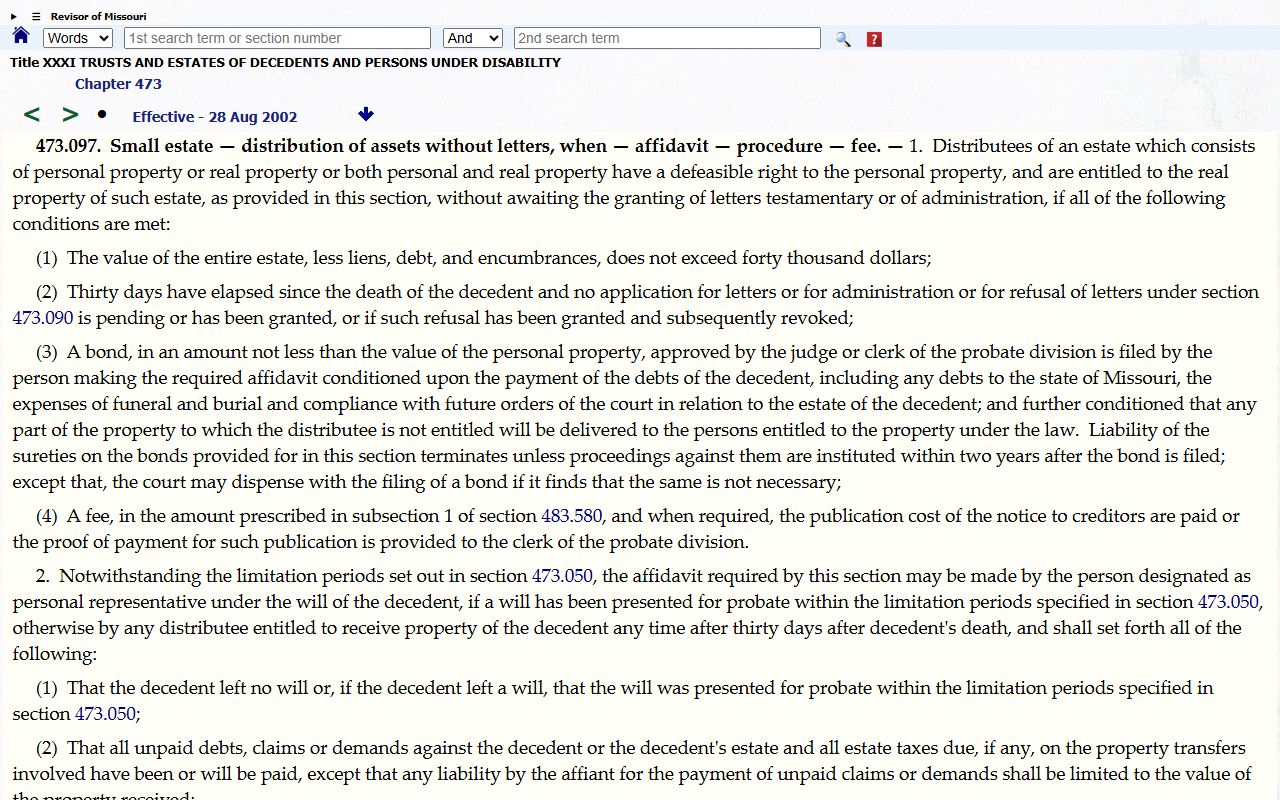
A small-estate filing still creates a court record, and certified copies of any resulting authority should be requested from the Circuit Clerk.
Newton County Probate Case Steps
The probate process depends on whether the case is a full estate, small estate, refusal of letters, guardianship, conservatorship, or trust dispute. Still, many estate files follow the same record path from petition to final settlement. Each step can add docket entries, notices, inventories, claims, orders, or certified letters to the court file.
- Identify whether there is a will and whether Newton County is the proper venue.
- File the application or petition with the Probate Division of the Circuit Court.
- Wait for appointment, letters, refusal, or small-estate authority, depending on the request.
- Provide notice to heirs, devisees, creditors, or interested parties when required.
- Inventory assets, manage claims, address taxes, and seek authority for transfers or sales as needed.
- File settlements, accounting, or closing documents and request discharge or closure.
Newton County Probate Fees
A Newton County probate fee schedule was not located in official local sources. Probate filing deposits and court costs can vary by case type, statewide cost rules, service needs, publication requirements, and whether certified copies are ordered. The safest fee channel is the Circuit Clerk before filing, especially for guardianship, conservatorship, estate administration, or a certified-copy request with several documents.
| Probate item | Amount or source status |
|---|---|
| Original estate application | Fee not located in official Newton County sources |
| Small-estate affidavit filing | Confirm with the Circuit Clerk |
| Guardianship or conservatorship filing | Confirm with the Circuit Clerk |
| Certified probate copy | Confirm document and certification cost with the Circuit Clerk |
| Publication, service, or notice costs | May depend on case needs and court instructions |
Note: Do not use another Missouri county's probate fee sheet as a Newton County amount unless the Circuit Clerk confirms it.
What Newton County Probate Records Show
A public Newton County probate file may show the case number, filing date, case type, court division, party names, attorneys, docket entries, notices, orders, letters, inventories, claims, annual or final settlements, receipts, waivers, and closing entries. Estate cases often identify a decedent, personal representative, heirs or devisees, creditor activity, and property administration. Guardianship and conservatorship cases may identify the protected person and appointed fiduciary, but public access can be narrower because the record may contain medical, financial, or minor information.
Probate records should not be treated as land-title abstracts. The Recorder of Deeds records deeds, releases, plats, surveys, and other instruments, while the probate division handles the court case. When an estate transfers real property, a user may need both the probate case file and the recorded instrument. That is one reason the Newton County Circuit Clerk and Recorder roles should not be merged.
Restricted Newton County Probate Records
Probate access is not all-or-nothing. Estate dockets can be public while particular exhibits, financial account numbers, medical materials, Social Security numbers, minor details, or sealed orders are withheld or redacted. Guardianship, conservatorship, mental-health, and civil-commitment matters are especially likely to include restricted details because they may concern capacity, care, treatment, or protected-person finances.
Public-defense resources are not probate records, but they appear in the Newton County research set because they help distinguish criminal indigent-defense channels from probate court access. The Missouri State Public Defender home page is a statewide source for criminal defense, not estate administration.
The contrast matters because a probate user should contact the Circuit Clerk or probate counter, while a criminal defendant seeking appointed counsel follows the public-defender process.
The public defender offices and contacts page is also separate from probate filing and copy channels.
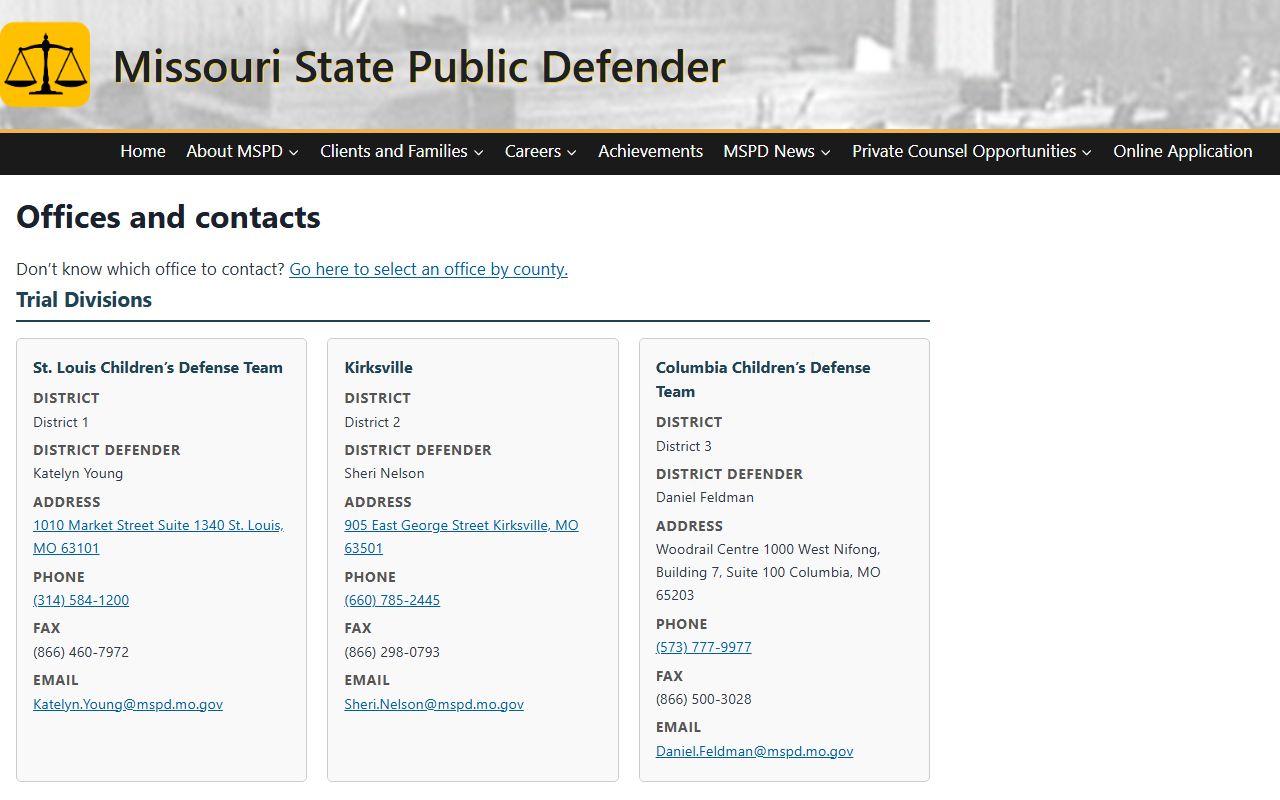
Keeping those channels separate prevents a records request from being sent to an office that does not keep probate case files.